🇬🇧 English
An English translation is available below the French article.
🇩🇪 Deutsch
Eine deutsche Übersetzung finden Sie im Anschluss an den französischen Artikel.
🇷🇺 Русский
Перевод на русский язык размещён ниже французского текста статьи.
Dans notre rubrique « À propos… », nous donnons la parole à des regards singuliers et libres.
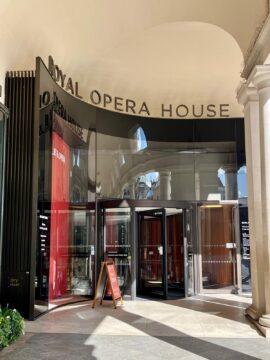
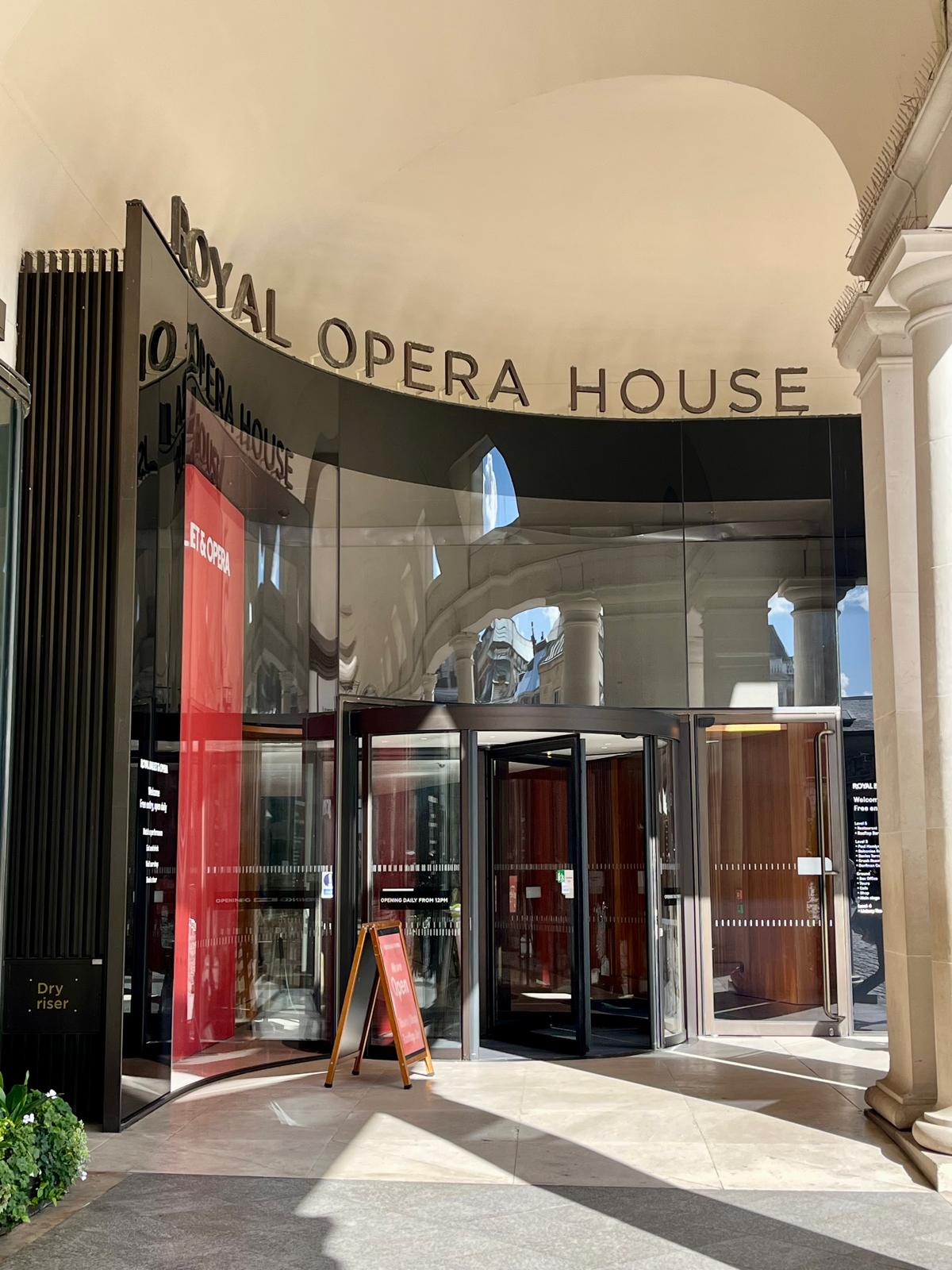
Irina Madec nous livre ici sa lecture très personnelle du Parsifal présenté au Royal Opera House de Londres. Séduite par la force et l’audace de la mise en scène d’Evgeny Titov, elle n’en exprime pas moins une profonde interrogation devant un dénouement qui, à ses yeux, remet en cause le sens même de l’œuvre de Wagner. Un regard passionné, sans concession, qui invite à la réflexion et au débat. (La Rédaction).
La mise en scène est une interprétation – Parsifal « updated »
Un innocent, inconscient, déconnecté de la réalité, surgit au milieu des survivants d’une guerre future imaginée. Le bunker, la douche de décontamination, la foule de rescapés qui cherche à survivre et à trouver le salut — au prix de la souffrance de celui qui doit les racheter. Un innocent, Parsifal, qui se retrouve mêlé à tout cela presque malgré lui (pas connecté aux infos ? Hors réseaux ?). Il n’est pas de ce temps.
Les tableaux scéniques qui le plongent dans cette réalité sont puissants.
Et particulièrement la fameuse scène de la cérémonie du Graal.
Comme chacun sait, dans la liturgie, au moment de la consécration eucharistique, le prêtre reprend les paroles du Christ lors de la Cène : « Buvez-en tous, car ceci est mon sang, le sang de la Nouvelle Alliance, versé pour vous et pour beaucoup, en rémission des péchés. »
Selon la tradition chrétienne, le sang du Christ, recueilli au moment de la Crucifixion par Joseph d’Arimathie, aurait été conservé dans un récipient devenu le Saint Graal, objet convoité pendant des siècles par l’Église et la chevalerie. Dans Parsifal, il devient le centre du rituel sacré de la communauté du Graal.
Mais… pourquoi le Graal devrait-il nécessairement être un objet ?
Dans la mise en scène d’Evgeny Titov, le réceptacle du sang du Christ devient le corps même d’Amfortas. Le sens du rituel demeure, mais il devient infiniment plus cruel :
La communauté des chevaliers consomme le sang directement de sa blessure.
Le sang du Christ est devenu le sang d’Amfortas. Une vision d’une grande puissance, d’une réelle violence.
Le moment de vérité Kundry-Parsifal
Un autre tableau signifiant, presque une icône. Au moment où Kundry raconte à Parsifal l’histoire de ses origines, elle est agenouillée sur la scène, avec Parsifal allongé en position fœtale, perpendiculaire à son ventre. Ce tableau immobile compose la vision saisissante d’une femme enceinte — ou d’une maternité primitive, presque sacrée. C’est Kundry qui fait naître en Parsifal la conscience, qui lui révèle son nom, qui lui révèle son passé, car sans passé, il n’y a pas d’avenir. L’illustration parfaite. La profondeur de la musique fait grandir toute la puissance de ce message.
Les Filles-Fleurs
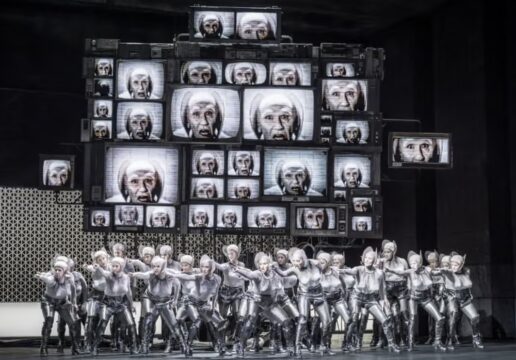
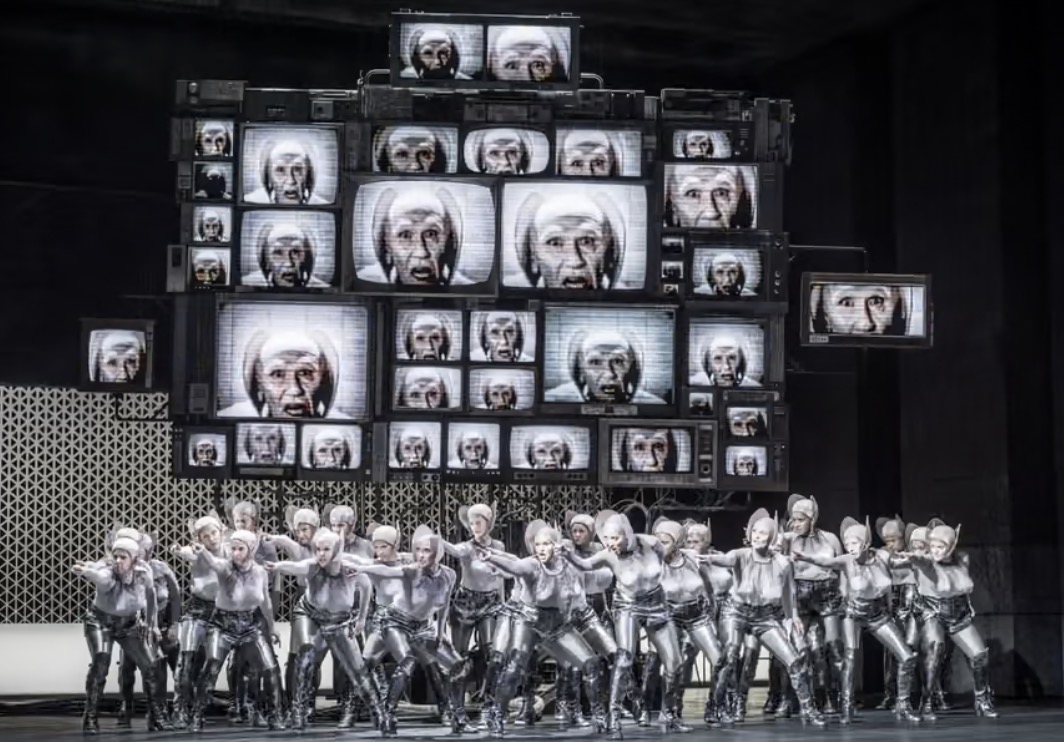
Les Filles-Fleurs, transformées en sortes de zombies extraterrestres issus, peut-être, des catastrophes d’une guerre future, sont parfaites et effrayantes.
Leur perfection standardisée et artificielle fait penser aux images créées par l’IA, lorsque tous les paramètres sont réunis pour faire le beau, mais que le résultat, déshumanisé, ne touche pas.
La chorégraphie est belle, et cette vision de séduction standardisée demeure harmonieuse et cohérente avec l’univers créé par Titov.
La scène finale
Mais ce qui provoque une véritable rébellion de l’esprit, c’est le dénouement :
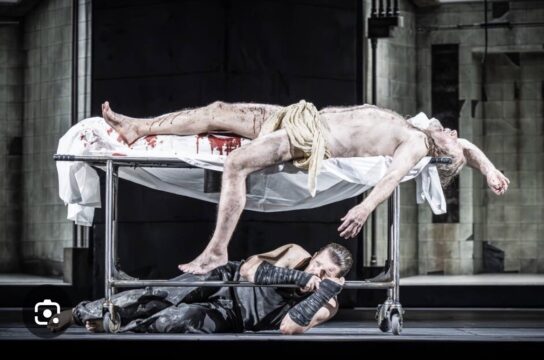
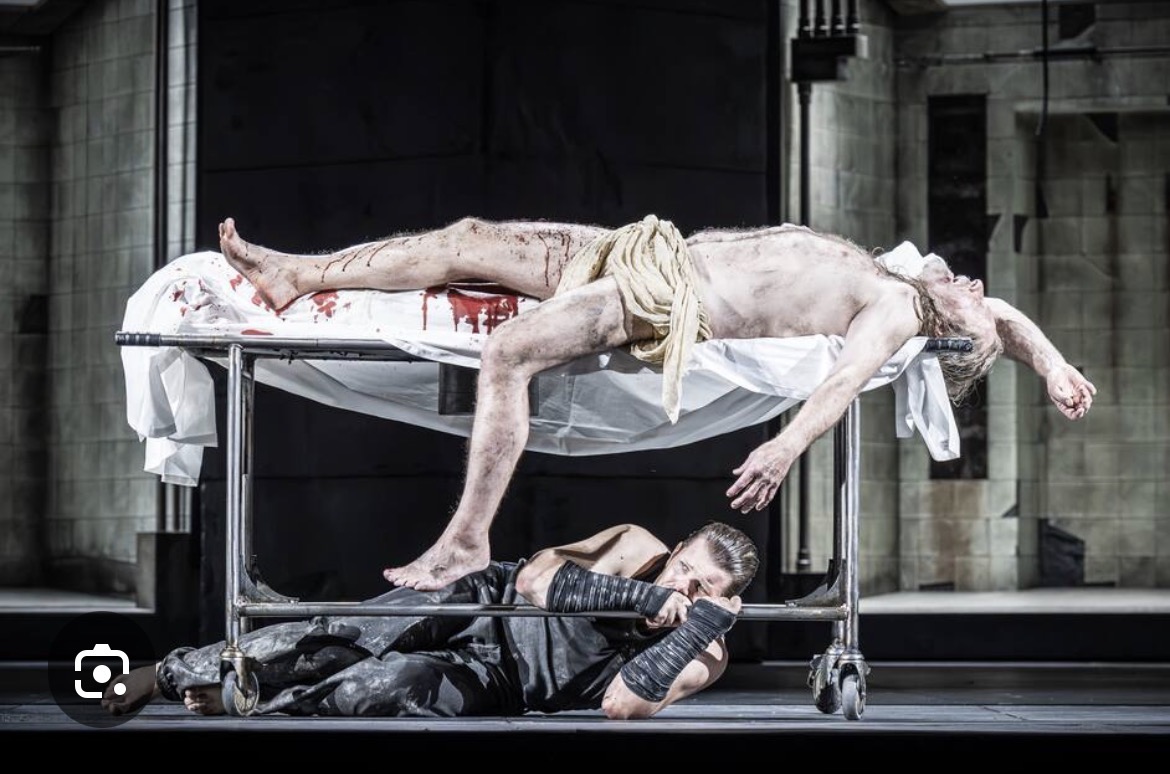
Parsifal, incapable de sauver, de guérir, de délivrer Amfortas, le tue (!!!).
Puis, après avoir accompli cet acte, il se couche sous le brancard où repose la dépouille, comme un chien battu.
C’est là que la lecture de Titov devient extrêmement difficile à accepter.
Parsifal, la dernière œuvre de Wagner, est souvent perçue comme son testament. Il est difficile d’imaginer que Wagner, qui avait fait des dieux une étape de l’histoire de l’humanité et interrogé la capacité de l’homme à dépasser sa condition, puisse accepter une telle inversion du principe même de la rédemption.
Car la rédemption du Rédempteur — la délivrance d’Amfortas par Parsifal — est précisément l’un des sens fondamentaux de l’œuvre.
Ici, ce sens est détourné. La rédemption devient meurtre. Le salut devient impossibilité. Et Parsifal, au lieu de devenir celui qui délivre, devient celui qui détruit le dernier espoir.
C’est un choix extrêmement sombre et désespéré, qui transforme profondément le message de Wagner.
Et c’est précisément ce qui risque de rendre l’ensemble de la mise en scène difficile à accepter pour les fidèles de Wagner et pour ceux qui connaissent profondément Parsifal.
C’est dommage, car cette proposition contient par ailleurs énormément de sens. Elle est audacieuse, visuellement puissante, souvent très belle et suffisamment avant-gardiste pour faire réellement réfléchir.
Mais ce tableau final est si radical qu’il risque de rendre impossible, pour une partie du public, l’acceptation de tout ce qui précède.
Et pourtant, c’est peut-être précisément là que réside la force — et la limite — de cette mise en scène : Titov ne se contente pas d’actualiser Parsifal. Il en conteste le salut.
Irina Madec
Nouvelle production de Parsifal de Richard Wagner, présentée au Royal Opera House de Londres du 1er au 17 octobre 2026 — Direction musicale : Jakub Hrůša.

ENGLISH
In our “À propos…” (“Perspectives”) section, we give a voice to distinctive and independent viewpoints.
Here, Irina Madec offers her highly personal reading of Parsifal, presented at London’s Royal Opera House. Captivated by the power and boldness of Evgeny Titov’s staging, she nevertheless raises profound questions about an ending which, in her view, challenges the very meaning of Wagner’s work. A passionate, uncompromising perspective that invites reflection and debate. (The Editors)
Every Staging Is an Interpretation – Parsifal “Updated”
An innocent, oblivious and disconnected from reality, appears among the survivors of an imagined future war. A bunker, a decontamination shower, a crowd of survivors struggling to stay alive and find salvation — at the cost of the suffering of the one who is supposed to redeem them.
An innocent, Parsifal, who finds himself caught up in all this almost against his will (doesn’t follow the news? Not on social media?). He does not belong to this age.
The stage tableaux that immerse him in this reality are powerful.
And particularly the famous scene of the Grail ceremony.
As everyone knows, in the liturgy, at the moment of the Eucharistic consecration, the priest repeats Christ’s words at the Last Supper: “Drink from it, all of you, for this is my blood, the blood of the New Covenant, shed for you and for many for the forgiveness of sins.”
According to Christian tradition, Christ’s blood, collected by Joseph of Arimathea at the time of the Crucifixion, was preserved in a vessel that became the Holy Grail, an object sought for centuries by the Church and by knights. In Parsifal, it becomes the centre of the Grail community’s sacred ritual.
But… why must the Grail necessarily be an object?
In Evgeny Titov’s staging, the vessel containing Christ’s blood becomes Amfortas’s own body. The meaning of the ritual remains, but it becomes infinitely more cruel:
The community of knights drinks the blood directly from his wound.
Christ’s blood has become Amfortas’s blood. A vision of tremendous power and genuine violence.
The Moment of Truth: Kundry–Parsifal
Another meaningful stage tableau, almost an icon. As Kundry tells Parsifal the story of his origins, she kneels onstage, with Parsifal lying in the foetal position, at right angles to her abdomen. This motionless tableau creates the striking image of a pregnant woman — or of a primordial, almost sacred motherhood.
It is Kundry who awakens consciousness in Parsifal, who reveals his name to him, who reveals his past, because without a past there can be no future.
A perfect illustration. The depth of the music magnifies the full power of this message.
The Flower Maidens
The Flower Maidens, transformed into something resembling extraterrestrial zombies, perhaps born of the catastrophes of a future war, are perfect and terrifying.
Their standardised, artificial perfection recalls images generated by AI, when every parameter has been brought together to produce beauty, yet the dehumanised result fails to move us.
The choreography is beautiful, and this vision of standardised seduction remains harmonious and consistent with the world Titov has created.
The Final Scene
But what provokes a genuine rebellion of the mind is the ending:
Parsifal, unable to save, heal or free Amfortas, kills him (!!!).
Then, having committed this act, he lies down beneath the stretcher on which the body rests, like a beaten dog.
This is where Titov’s interpretation becomes extremely difficult to accept.
Parsifal, Wagner’s final work, is often regarded as his testament. It is difficult to imagine that Wagner, who had made the gods a stage in the history of humanity and questioned mankind’s ability to transcend its own condition, could have accepted such a reversal of the very principle of redemption.
For the redemption of the Redeemer — Amfortas’s deliverance through Parsifal — is precisely one of the work’s fundamental meanings.
Here, that meaning is subverted. Redemption becomes murder. Salvation becomes impossible. And Parsifal, instead of becoming the one who brings deliverance, becomes the one who destroys the last hope.
It is an extraordinarily dark and despairing choice, one that profoundly transforms Wagner’s message.
And it is precisely this that may make the entire production difficult to accept for devoted Wagnerians and those who know Parsifal intimately.
It is a pity, because this production is otherwise extraordinarily rich in meaning. It is bold, visually powerful, often very beautiful, and sufficiently avant-garde to provoke genuine reflection.
But this final tableau is so radical that, for some members of the audience, it may make everything that came before impossible to accept.
And yet, perhaps this is precisely where both the strength — and the limitation — of this staging lie: Titov does not merely update Parsifal. He challenges the very idea of salvation at its heart.
Irina Madec
New production of Richard Wagner’s Parsifal, presented at London’s Royal Opera House from 1 to 17 October 2026 — Musical direction: Jakub Hrůša.
DEUTSCH
In unserer Rubrik „À propos…“ („Betrachtungen“) geben wir eigenständigen und unabhängigen Stimmen Raum.
Irina Madec präsentiert uns hier ihre ganz persönliche Lesart des Parsifal, der am Royal Opera House in London aufgeführt wird. Begeistert von der Kraft und Kühnheit der Inszenierung Evgeny Titovs, äußert sie zugleich tiefgreifende Zweifel an einem Schluss, der ihrer Ansicht nach den eigentlichen Sinn von Wagners Werk infrage stellt. Ein leidenschaftlicher, kompromissloser Blick, der zum Nachdenken und zur Diskussion einlädt. (Die Redaktion)
Jede Inszenierung ist eine Interpretation – Parsifal „updated“
Ein Unschuldiger, ahnungslos, von der Wirklichkeit abgekoppelt, taucht mitten unter den Überlebenden eines imaginären zukünftigen Krieges auf. Ein Bunker, eine Dekontaminationsdusche, eine Menge Überlebender, die ums Überleben kämpft und nach Erlösung sucht — um den Preis des Leidens dessen, der sie erlösen soll.
Ein Unschuldiger, Parsifal, der beinahe gegen seinen Willen in all dies hineingerät (verfolgt er keine Nachrichten? Ist er nicht in den sozialen Netzwerken?). Er gehört nicht in diese Zeit.
Die szenischen Bilder, die ihn in diese Wirklichkeit hineinziehen, sind eindrucksvoll.
Ganz besonders die berühmte Szene der Gralszeremonie.
Wie allgemein bekannt, wiederholt der Priester in der Liturgie während der eucharistischen Wandlung die Worte Christi beim Letzten Abendmahl: „Trinket alle daraus; denn dies ist mein Blut, das Blut des Neuen Bundes, das für euch und für viele vergossen wird zur Vergebung der Sünden.“
Nach christlicher Überlieferung wurde das Blut Christi, das Joseph von Arimathäa bei der Kreuzigung aufgefangen haben soll, in einem Gefäß aufbewahrt, das zum Heiligen Gral wurde — einem Gegenstand, nach dem Kirche und Rittertum jahrhundertelang strebten. In Parsifal wird er zum Mittelpunkt des heiligen Rituals der Gralsgemeinschaft.
Aber… warum muss der Gral unbedingt ein Gegenstand sein?
In Evgeny Titovs Inszenierung wird Amfortas’ eigener Körper zum Gefäß für das Blut Christi. Der Sinn des Rituals bleibt erhalten, doch es wird unendlich grausamer:
Die Gemeinschaft der Gralsritter trinkt das Blut unmittelbar aus seiner Wunde.
Das Blut Christi ist zum Blut des Amfortas geworden. Eine Vision von ungeheurer Kraft und erschütternder Gewalt.
Der Augenblick der Wahrheit: Kundry–Parsifal
Ein weiteres bedeutungsvolles szenisches Tableau, beinahe eine Ikone. Während Kundry Parsifal die Geschichte seiner Herkunft erzählt, kniet sie auf der Bühne. Parsifal liegt in Embryonalstellung, im rechten Winkel zu ihrem Bauch. Dieses unbewegte Tableau lässt das eindrucksvolle Bild einer schwangeren Frau entstehen — oder das einer ursprünglichen, beinahe heiligen Mutterschaft.
Kundry ist es, die in Parsifal das Bewusstsein erweckt, die ihm seinen Namen offenbart, die ihm seine Vergangenheit erschließt. Denn ohne Vergangenheit gibt es keine Zukunft.
Eine perfekte Veranschaulichung. Die Tiefe der Musik lässt die ganze Kraft dieser Botschaft noch wachsen.
Die Blumenmädchen
Die Blumenmädchen, verwandelt in eine Art außerirdischer Zombies, die vielleicht aus den Katastrophen eines zukünftigen Krieges hervorgegangen sind, wirken vollkommen und erschreckend zugleich.
Ihre normierte, künstliche Perfektion erinnert an KI-generierte Bilder, bei denen sämtliche Parameter darauf ausgerichtet sind, Schönheit hervorzubringen, deren entmenschlichtes Ergebnis jedoch nicht berührt.
Die Choreografie ist schön, und diese Darstellung einer standardisierten Verführung bleibt harmonisch und fügt sich schlüssig in die von Titov geschaffene Welt ein.
Die Schlussszene
Was jedoch einen regelrechten inneren Aufruhr auslöst, ist der Schluss:
Parsifal, unfähig, Amfortas zu retten, zu heilen oder zu erlösen, tötet ihn (!!!).
Nachdem er diese Tat begangen hat, legt er sich wie ein geprügelter Hund unter die Trage, auf der der Leichnam ruht.
An diesem Punkt wird Titovs Deutung äußerst schwer akzeptierbar.
Parsifal, Wagners letztes Werk, wird häufig als sein Vermächtnis betrachtet. Es fällt schwer, sich vorzustellen, dass Wagner, der die Götter zu einer Etappe in der Geschichte der Menschheit gemacht und die Fähigkeit des Menschen hinterfragt hatte, über seine eigene Existenz hinauszuwachsen, eine derartige Umkehrung des eigentlichen Erlösungsgedankens hätte akzeptieren können.
Denn die Erlösung des Erlösers — die Befreiung des Amfortas durch Parsifal — gehört gerade zu den grundlegenden Sinngehalten des Werkes.
Hier wird dieser Sinn ins Gegenteil verkehrt. Erlösung wird zu Mord. Heil wird unmöglich. Und Parsifal wird, statt zum Befreier zu werden, zu demjenigen, der die letzte Hoffnung zerstört.
Es ist eine außerordentlich düstere und hoffnungslose Entscheidung, die Wagners Botschaft tiefgreifend verändert.
Und genau das könnte dazu führen, dass die gesamte Inszenierung für eingefleischte Wagnerianer und für diejenigen, die Parsifal zutiefst kennen, nur schwer annehmbar wird.
Das ist bedauerlich, denn ansonsten steckt in dieser Inszenierung außerordentlich viel Sinn. Sie ist kühn, visuell eindrucksvoll, oft sehr schön und avantgardistisch genug, um tatsächlich zum Nachdenken anzuregen.
Doch dieses letzte Tableau ist so radikal, dass es einem Teil des Publikums unmöglich machen könnte, all das anzunehmen, was ihm vorausging.
Und dennoch liegt vielleicht gerade darin die Stärke — und zugleich die Grenze — dieser Inszenierung: Titov begnügt sich nicht damit, Parsifal zu aktualisieren. Er stellt die Erlösung selbst infrage.
Irina Madec
Neuproduktion von Richard Wagners Parsifal, aufgeführt am Royal Opera House in London vom 1. bis 17. Oktober 2026 — Musikalische Leitung: Jakub Hrůša.